
23 November 2026 | See disclaimer
Table of Contents
- Who can teach a learner driver?
- Are learner drivers covered by my insurance?
- Learner driver accident responsibility
- What to teach a learner driver
- Teaching a manual or automatic car (or EV)
- What to do when your learner isn’t a learner anymore
Who can teach a learner driver?
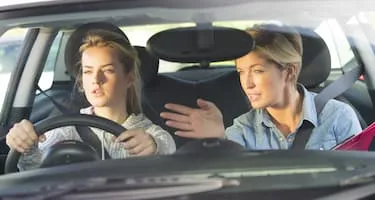
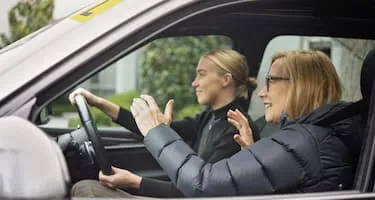
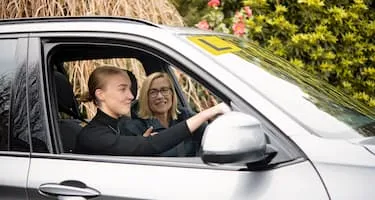
All learner drivers must be instructed by a supervisor. A supervisor can be anyone with an unexpired open licence of the correct class who has held it for a length of two years or more (depending on the state or territory).
Are learner drivers covered by my insurance?
Learner drivers can be covered by your car insurance as long as certain rules are followed.
First, make sure any driver-age restrictions are removed that impact your learner driver. If your policy currently has a restriction that only drivers aged 30+ can drive, but your driver is 16 years old, you’ll want to lift this restriction before your learner starts driving.
Second, if your learner driver lives in your home, add them to the list of household drivers.
You can make these changes by updating your policy in the policy manager or by calling us on 1300 306 560.
Where you need to check your insurance is when the supervisor isn’t the policy holder for the car. For example, let’s say you have an adult daughter who has an open licence and may or may not live in your home, and she is teaching your teenage son to drive in your car. You’d need to make sure to update your policy to remove any driver-age restrictions on who drives your car, and make sure your son and daughter are both listed as drivers on your car insurance.
If your children get into a collision during a lesson and you have Comprehensive Insurance, you’ll be covered for an insured event because they’re both listed on the policy.
Learner drivers can start their journey at any age, with options for lessons from family and friends and also from accredited driving instructors, or a mix thereof. Most professional instructors will teach learner drivers in their own driving school cars and have appropriate insurance coverage, but if you are teaching a learner in your car, make sure they’re listed on your policy.
Learner driver accident responsibility
The process after getting into an accident while supervising your learner is no different than what you would do if you got into an accident.
Make sure to:
- Ensure everyone involved in the crash is uninjured. If there is an injury, call Triple Zero (000) for an ambulance and/or other emergency services
- Trade information with the other driver, collecting their name, address, phone number, registration plate number, insurer, and driver’s licence number
- If the car is undriveable, call a tow truck. If you’re covered with Budget Direct’s Comprehensive Insurance, we can arrange a tow truck for you. The exception is if you are in Melbourne, Mornington Peninsula, Geelong and Adelaide, where you are required by law to call an “allocation centre” or “centralised operator”, who will arrange the tow truck on the driver’s behalf.
- Next, lodge an insurance claim. With our 24/7 claims system, you can make a claim online or call us on 1300 139 591
What to teach a learner driver and logbook requirements
Supervisors are responsible for facilitating a learner driver’s journey to becoming (hopefully) competent road users, so if you are considering teaching a learner driver, it might help to brush up on the road rules yourself before you start teaching others.
While it differs between all the states and territories, learner drivers under 25 years old usually have to complete either a physical or digital logbook. The Department of Infrastructure and Transport notes that logbooked hours can be as low as 50 hours in the ACT, or as high as 120 hours in NSW. They also require a specific amount of night driving hours. On the high end, NSW and Vic require 20 hours of night driving, while the ACT requires 10 hours.
A feature of learner logbooks in some states and territories is 1=3 system whereby one hour of driver training under a professional instructor equals three hours of logbook attributable time. This, along with other driver training and education sessions being offered in some states and territories, can be counted toward those logbook totals to make getting to the hours needed to progress a lot more attainable.
Teaching a manual or automatic car (or EV)
Learner drivers are allowed to get their learner logbook hours in manual or automatic cars, as long as specific rules are followed.
When teaching your learner driver, make sure the vehicle you’re driving matches the class of the current licence you have. For example, if you have a licence class that only lets you drive automatic cars, you cannot teach a learner how to drive in a manual car in most states and territories. Conversely, be aware that in most states and territories, if the driver learns to drive in an automatic car and does their test in an automatic car, they will get a licence class to only drive automatic cars, no matter the type of licence their supervisor has.
Learner drivers can also learn in EV vehicles, but make sure that the supervisor has the appropriate licence type. For example, in South Australia, drivers must have a U class licence to drive cars that have a gross vehicle mass of up to 4.5 tonnes and a power to weight ratio of 276 kilowatts per tonne or more, which is mainly applicable to supercars or performance EV models. Always make sure the supervisor’s licence is appropriate to the rules of that state or territory.
What to do when your learner isn’t a learner anymore
Once your learner driver has passed their test, it’s time to make sure they are protected when they have a car of their own. At Budget Direct, we offer Third Party Property Only, Third Party Property, Fire and Theft, or Comprehensive insurance. So whichever is the best choice for your new driver, they can receive 15%^ off their first year’s premium when they order online.
See More Guides